
Pat The Fox Man and I set off on our historical tour. Pat has never been in Jerpoint Abbey before, and it was fantastic that he had got a tour guide to himself. I and my camera were trailing behind them.
In the pictures: Pat Gibbons and his tour guide Margaret Brophy. I was delighted that Pat had such a knowledgeable guide. Their conversation went beyond the history of the abbey to the history of the whole parish.

Originally a Benedictine monastery built in 1160, Jerpoint Abbey was affiliated to the Cistercian Order in 1180. Scholars believe that Domnall I, the king of Ossory who died in 1176, was possibly the founder of the monastery. This is supported by a charter of King John to Jerpoint Abbey confirming the lands granted by Domnall. The grant happened before Strongbow arrived in Leinster in 1170.
The restoration works are on in the abbey. Some areas are fenced and the north aisle is closed.

You can see the scaffolding in the north isle, behind the arcade of pointed arches supported by large piers. There are six arches, with different design on each pier. Margaret and Pat are walking to the Romanesque west nave – the lay brothers’ choir. It is the place where the lay brothers gathered to attend Mass. The nave originally had an arcaded aisle on both sides. There is a special room in the museum where all the broken pieces of masonry – particularly the parts of arches and piers – are stored and can be viewed by the visitors.

The west nave window comprises of three round-headed lights.
The Monk’s choir is the east part of the nave.
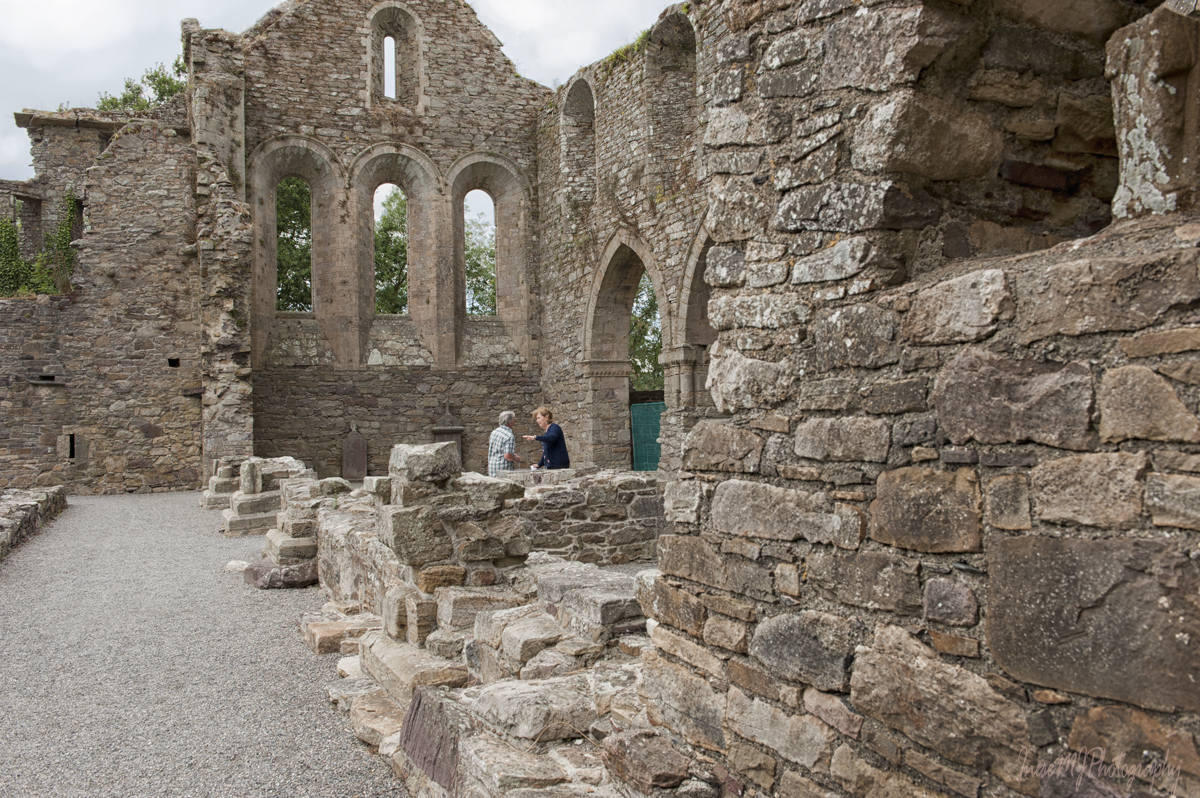
This is what the windows look like in the morning light from the main road.

The crossing tower above the intersection of the chancel, nave and transept was added in the 15th century. Towers were not allowed by the Order’s authority at the time the monastery was built. The rib vaulting of the tower’s ceiling is well preserved. The pointed arches open to the nave, chancel and both transepts. Each transept has two chapels on the east side.
There are a tomb and funeral slabs in the crossing.
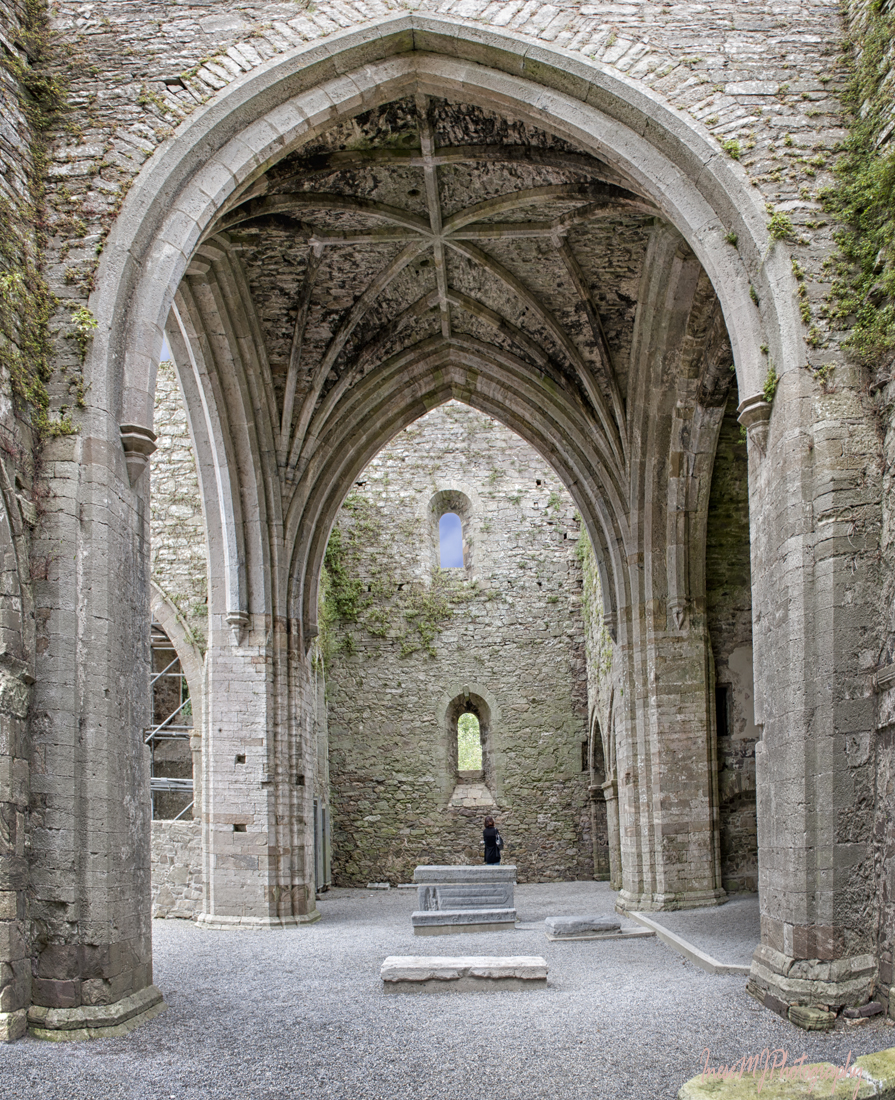
I went to the north transept to check out the chapels. And this is what I found.
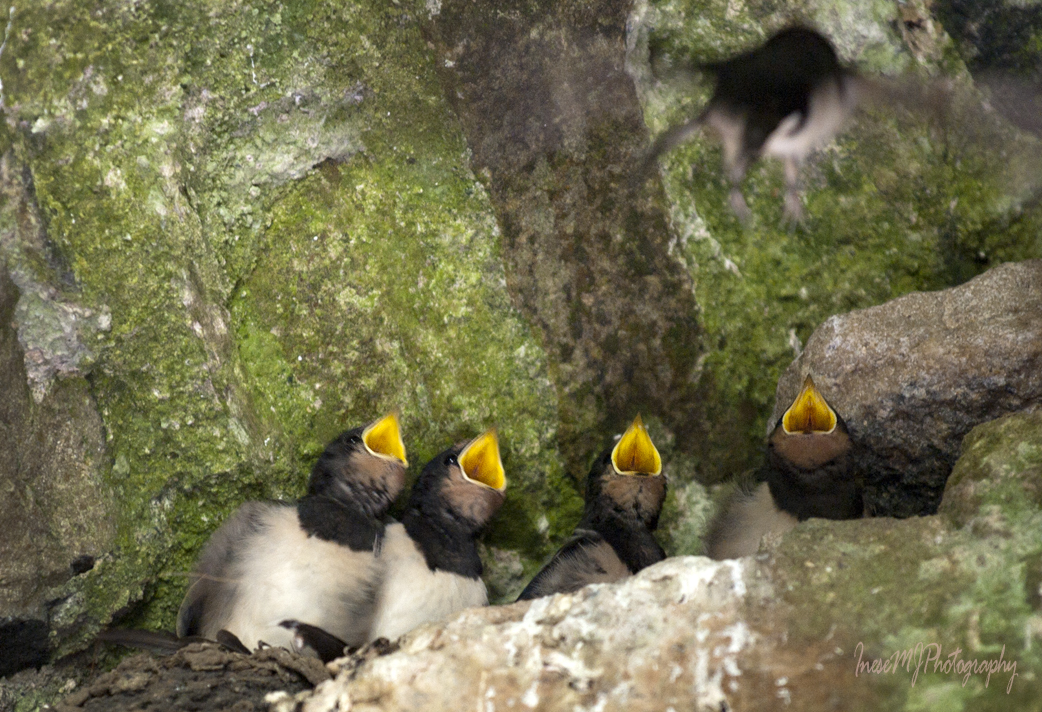
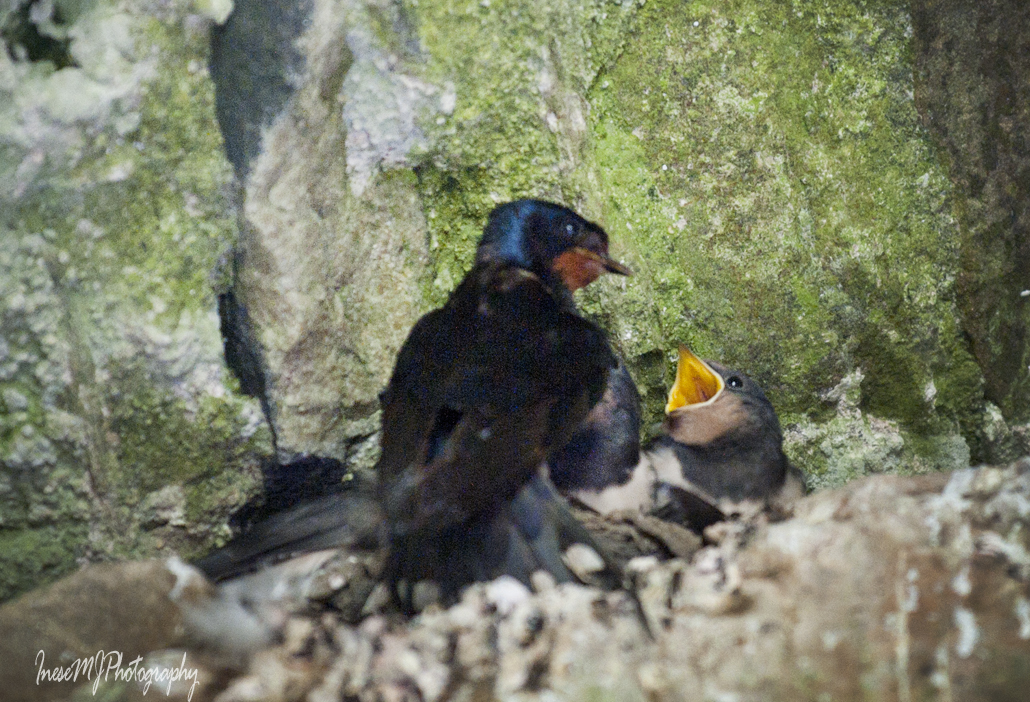
Of course I stuck there for a long time watching the mama swallow and her “yellow-lipped” babies.

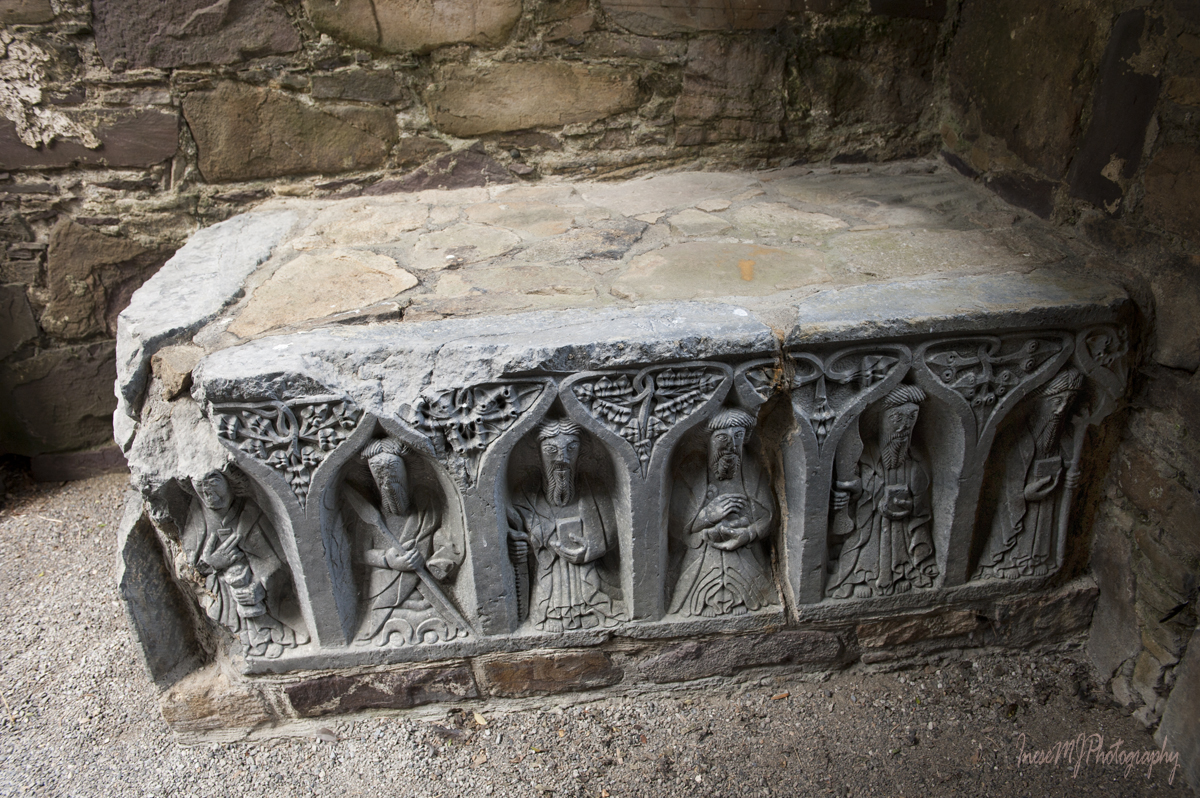
There is something else quite amazing in the chapels – beautifully carved tomb weepers decorating the mensa-tomb chests. In the picture below you see six weepers – the apostles who can be recognized by the attributes related to the manner of their martyrdom. From the left: St John with a chalice; St Thomas with a lance; St Simon with a saw; St Bartholomew with skin – it is believed he was flayed alive; St Paul holding a sword, and St Matthew an axe. The carvings were made by the sculptor Rory O’Tunney of Callan.
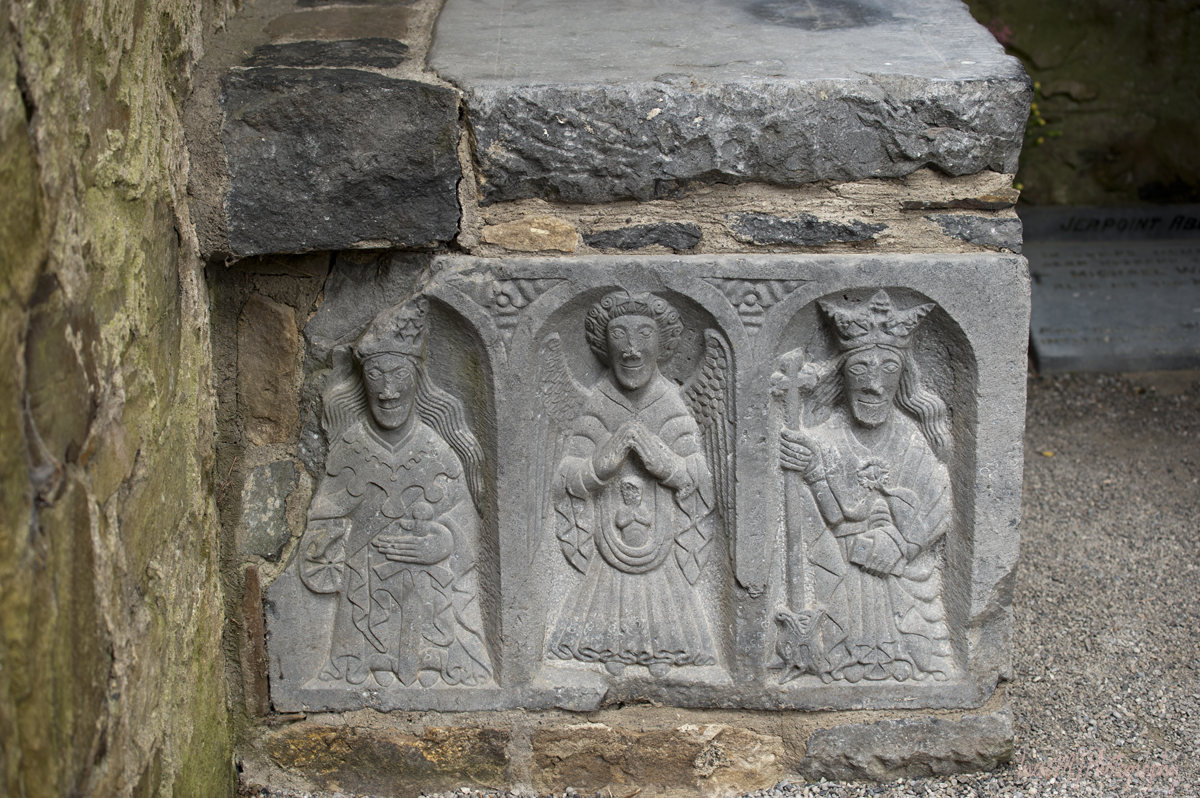
These weepers are St Catherine of Alexandria with a wheel, St Michael the Archangel in the centre, and St Margaret of Antioch wearing a ring broach and stomping on a dragon’s head.
I left the chapels and went to the presbytery to admire the ancient wall paintings.
In the image below, you see three tomb niches in the wall under the painted fragment. It is where two tomb effigies from the next picture were originally placed.

The tomb effigy in background represents Felix O’Dulany, the first Abbot of Jerpoint praised for his ‘zeal, charity and prudence’. The other effigy (foreground) possibly represents Donal O’Fogarty, another bishop of the Diocese of Ossory.
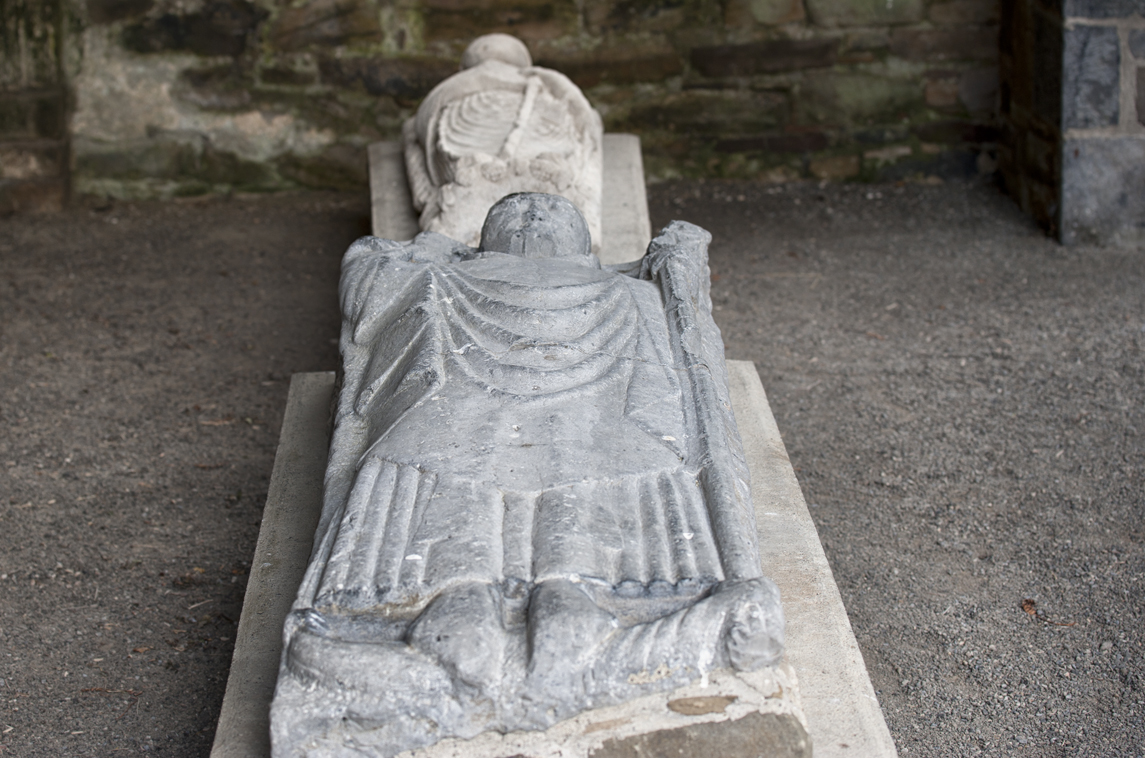
Bishop O’Dulany died in 1202. They say ‘many miracles were wrought by him’. The face of the effigy is badly worn: it was believed that pilgrims touching the face would be cured of their illnesses.

This is a 15-16th century wall painting after the restoration works. You can see the fragments of two shields with the scallop shells and wild boars – four shells and possibly four boars. Scallop shells represent St James and are the symbol of pilgrimage. I am not sure about the boars. Usually they represent ferocity and power. I should have listened to Margaret’s explanation instead of looking for birds 🙂

The abbey is famous for its large number of stone carvings untypical for a Cistercian monastery. You will find amusing figures of animals and fantastic creatures, knights, damsels, monks and smiling bishops carved on the piers. There are so many carvings that when you come again you will find something new you haven’t seen before.
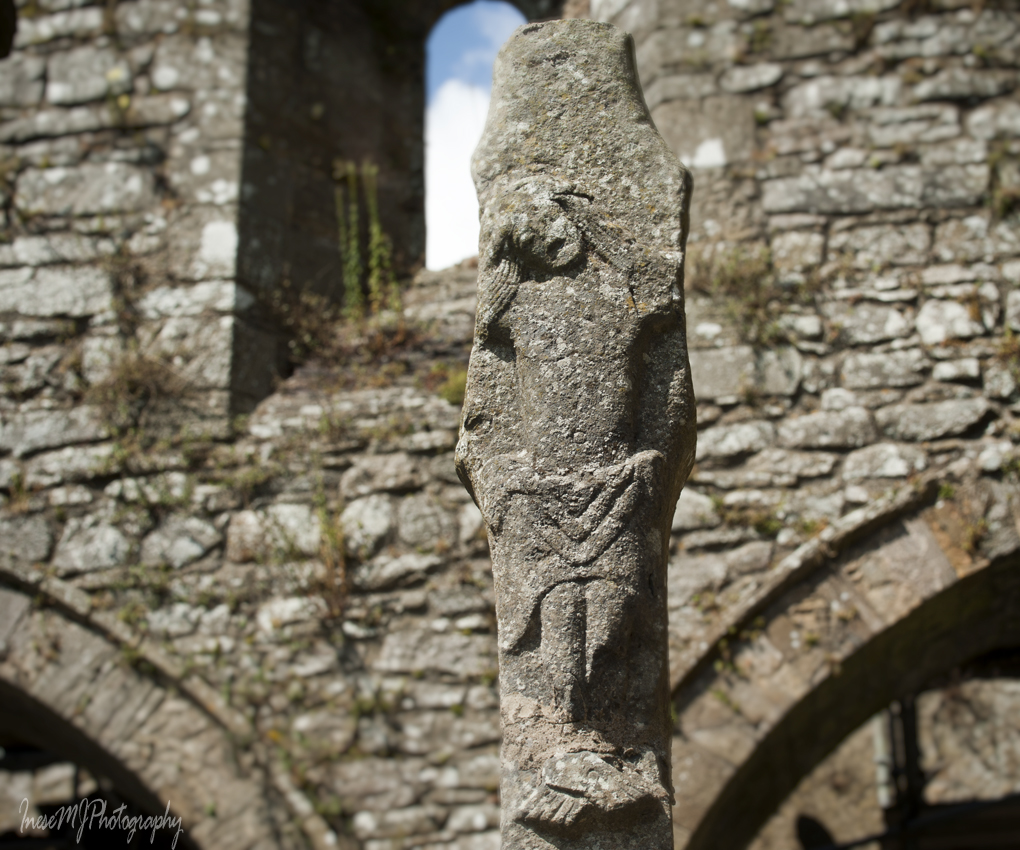
The west part of the cloister arcade is reconstructed. You will find many lay and religious carvings there, and learn about the armor and clothing worn at the times.
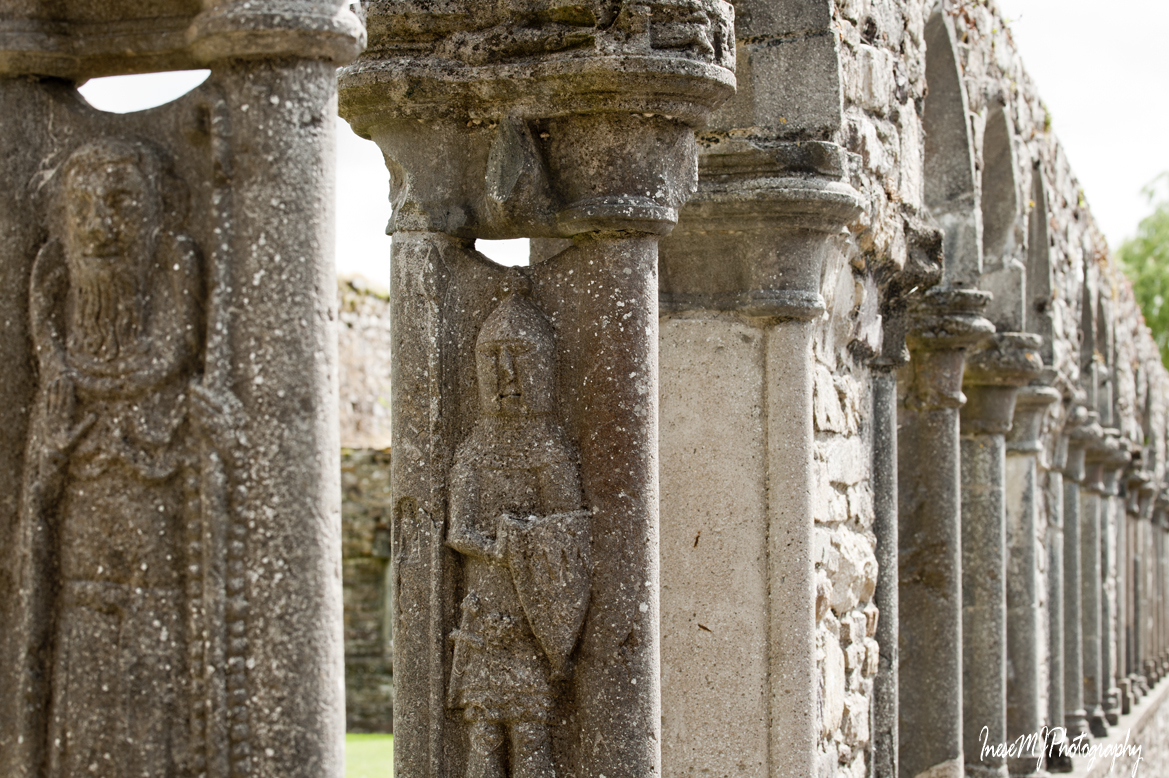
The famous ‘man with the stomach ache’.


View of the tower from the west side of the cloister arcade.

The south part of the cloister arcade also survive.

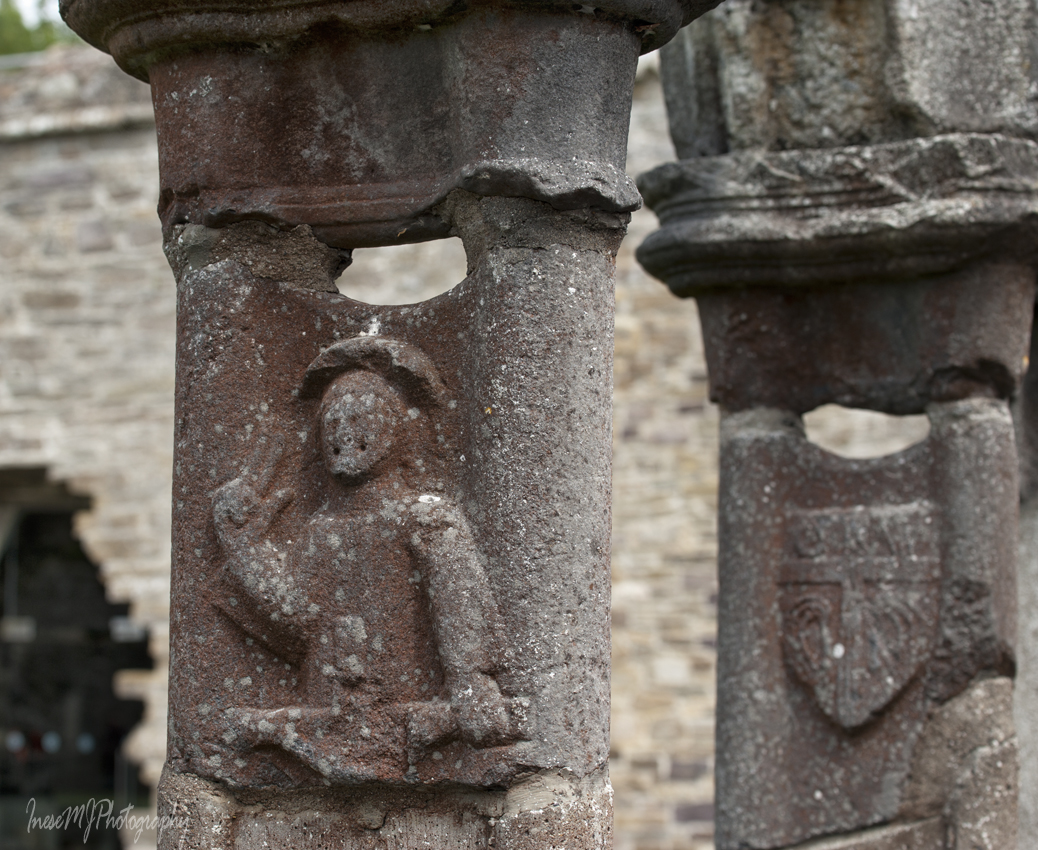
This part of the arcade would support the roof over the buildings like refectory (dining room) and calefactory (warming house) which are long gone.

As you see in the picture, there is an upper floor that can be reached from the south transept. It is where the monks’ dormitory was located. I want to return to the abbey next year, so I leave the upper floor for my future blog post.

Beautiful Gothic east window dates from the 14 century. You can see the outer halves of two old Romanesque windows – originally a triple window.

Clicking on this link you will find a detailed map of the abbey.
The graves around the abbey date from centuries ago to the present time.


We visited Jerpoint Abbey on a fine sunny day. I want to share a different mood – a poem written by Waterford-born journalist Samuel Carter Hall in 1823, and a series of photographs taken on a gray and foggy morning – all of this in the article written by an author and lecturer Robert O’Byrne.
You have visited one of the finest historical places in Co Kilkenny. Our day out isn’t over yet. It continues to the next blog post 🙂
 Have a wonderful weekend!
 Making memories
Great blog Inese – this Abbey seems like a place your could spend a long time walking around and photographing. I love the old history – it is so interesting. And of course the birds were perfect as always. Looks like a great day.
Thank you, Syd! It was dark in the chapel and the pictures didn’t come out well, but what a fun it was to watch the little birds open their yellow mouths. Their mother fed them one at a time, and it lasted a second. It was a very challenging photography 🙂
very interesting history and beautiful images.
Thank you! 🙂
It’s all brilliant, but the yellow-lipped birds make for wonderful photography. ~ George
I just couldn’t resist 🙂
I really love your tour of this place. Those pictures are fantastic. You captured them very nicely!
Thank you so much! 🙂 It is a very interesting place with a long history.
I love visiting places like that. It must have been majestic in its day.
Yes, imagine all the roofs on, plastering, busy monks. Some place.
Very nice!
Thank you!
You’re welcome.
May I just say, I was so glad you and your camera were trailing behind in terms of the pics … xxxxx
You give the best tours! Wonderful piece and photos.
Thank you! It is a great place to visit, and you can also meet Pat the Fox Man as he lives just a few minutes away.
That would be a treat.
Wow! It’s hard for me to wrap my head around the fact that all of this still exists after centuries. Absolutely amazing! And beautiful! Love your little birds, too! 😀
Thank you! Yes, it is difficult to imagine anything still standing after some 700-800 years. Jerpoint Abbey has a National Monument status since the 19th century.
A fascinating tour thank you Inese.
Thank you for reading! This place is unique.
It’s fabulous! I love learning about it all. I’m so happy you took Pat! It’s like good things going around in circles. I mean he takes care of the foxes, and you take him to the abbey! xoxo
Thank you, Resa 🙂 Pat loves history and knows a lot too. In my next blog we are visiting a site of his choice 🙂 xxxxxx
xxxxxxx 😀 He must adore you!
Good to see, that Pat had his trip, Inese 😀
Interesting as usual to travel around with you.
Wish you a beautiful weekend.
Thank you, Irene! Yes, I was delighted to take him to the Abbey. On the way back we visited another old ruin. I will write about this in my next blog post 🙂
I love visiting these places from afar. I am unlikely to ever have the funds to visit in person, but I enjoy these tours online.
Thank you so much for taking the tour.
Looks like the Abbey has its own young avian choir 🙂
Rosaliene, there were so many more birds around! It seems that they are interested in the insects living between the stones. I saw goldfinches and sparrows and wagtails foraging on the walls.
How great that they have found a sanctuary!
Thanks for the history, Inese….I visited Jerpoint a couple of years ago, but didn’t have a tour
Oh that is so wonderful you did. I hope you discovered all the amazing carved figures and the weepers.
I wanted Pat to have a proper tour as it was his first time in the Abbey. Wanted to make it a special day for him.
Yes, I did my reading about what to see, and saw the Weepers
I wonder if the painting was already restored at the time of your visit.
No, I was referring to the Weepers on the tomb
Yes, I understood that. I was wondering about the boars and shells. I think this wall was restored only recently. Did you see it on your trip? It is in the room with the tomb effigies.
To be honest, I don’t recall it
It means it was hidden under all that lichens and all. I cannot find the information about the restoration works, it is why I am asking 🙂 Now the painted wall is well visible.
Ok!
Your photographs are breathtaking Ms inese. Such beauty resides in one place. A wonderful tour. Thank you for sharing! g
Thank you! There are so many carvings that you cannot discover all of them in one visit.
Fascinating history and architecture and I love the birdies!
Thank you! The place is amazing.
Great place❣
Thank you Luisa! There are so many carvings like nowhere else.
Wonderful, as always. Thank you. Liked and shared. Take care.
__
https://twitter.com/outosego/status/1172908903371288584
Thank you so much! It is special place.
abbey was awesome – but those baby birds – awe. heart tug
Thank you! I always get distracted when I see a bird 🙂
🙂